
In this guide 7 sections
- 1 Can you drive a van on a car licence?
- 2 What is maximum authorised mass, and where do I find it?
- 3 I passed my test before 1997. What extra can I drive?
- 4 Does my car insurance cover a van?
- 5 Can I drive a hired van on a car licence?
- 6 Can I carry passengers or goods for payment on a car licence?
- 7 What happens if the van is over my licence?
The question comes up on moving day, at the hire counter, or when a friend with a trade asks for a hand. The answer is yes for almost every van on the road, and the reason people doubt it is that they are judging by size. The licence does not care how long or tall a van is. It cares about one number on a plate inside the door.
Can you drive a van on a car licence?
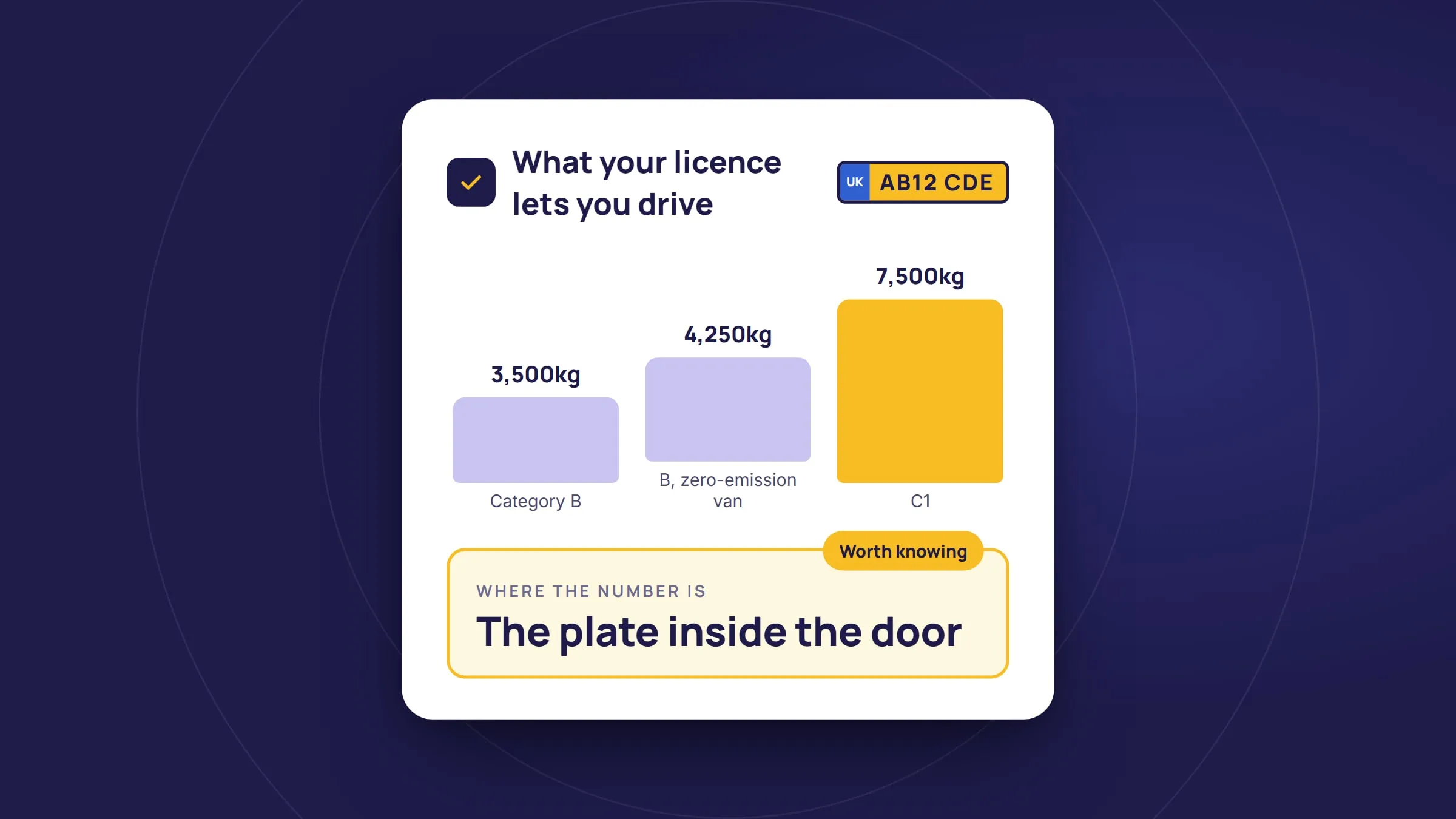
Yes, up to a maximum authorised mass of 3,500kg and eight passenger seats. That is every ordinary panel van, Luton and pickup. Zero-emission vans can go to 4,250kg on the same licence.
GOV.UK sets out category B: vehicles with up to eight passenger seats and a maximum authorised mass of 3,500kg for petrol, diesel and hybrid vehicles, or 4,250kg for electric and hydrogen vehicles. A trailer up to 3,500kg can be towed behind it, with the combined figure not exceeding 7,000kg.
That covers the Transit, the Sprinter, the Vivaro, the Crafter, the Luton on any of them, and the double-cab pickup, in their 3.5-tonne forms. The exceptions are the heavier variants that the same manufacturers plate at 4,000kg or 5,000kg, and anything with a crew cab and a tipper body that has crept over.
What is maximum authorised mass, and where do I find it?
The weight of the van plus the most it may carry, as the manufacturer plated it. It is on a plate inside the driver’s door frame or under the bonnet, in the manual, and on the V5C.
GOV.UK defines it as the weight of the vehicle including the maximum load that can be carried safely on the road, also called gross vehicle weight or permissible maximum weight. The plate shows it as the first figure; the second is the gross train weight with a trailer; the figures below are the axle limits.
Two things it is not:
- Not the kerb weight. An empty 3.5-tonne Luton weighs about 2,000kg. The licence test is the plated maximum, not what it weighs today.
- Not what you have loaded. Loading a van over its plated figure is an offence on its own and can void the insurance. A plated 3,500kg van is a 3,500kg van whether it is empty or full.
I passed my test before 1997. What extra can I drive?
C1, which covers vehicles from 3,500kg to 7,500kg, and D1 minibuses, without any further test. A licence issued on or after 1 January 1997 has category B only.
The older categories were wider. A driver who passed in 1996 can take a 7.5-tonne lorry or a horsebox out without a further test, subject to a medical from the age of 70. A driver who passed in 1998 cannot, and getting C1 means a medical, a theory test and a practical test in a vehicle of that class.
The dividing line is the date on the licence, not the driver’s age, and it is checked. Hire counters and insurers both read the categories on the photocard.
Does my car insurance cover a van?
No. A car policy covers the car on it. The driving other cars extension is third party only, for private cars, and normally excludes vans. A van needs its own policy.
This is the half of the question people forget. The licence says you may drive the van; the insurance says whether you are covered while you do. Driving other cars on a comprehensive policy, where the policy carries it at all, is third party only, applies to a motor car, and almost always excludes commercial vehicles. A borrowed van driven on the strength of a car policy is, in nearly every case, driven uninsured.
Temporary van insurance is the product for a borrowed or newly bought van: 1 hour to 28 days, comprehensive as standard, drivers aged 19 to 74 with a full UK licence, on vans up to 3,500kg worth up to £65,000 with some insurers, with age limits, the licence types accepted and the value band varying by insurer. Business class 1 is included; carrying your own goods is available with some insurers, and hire and reward is a separate courier product. It does not cover tools, cargo or goods in transit, and it does not cover hire vans.
Borrowing a van for the move? Cover from an hour, certificate as soon as you pay.
Get QuotesCan I drive a hired van on a car licence?
If it is plated at 3,500kg or under, yes. The rental company’s own insurance covers it, usually with a large excess, and a temporary van policy will not replace that cover.
Rental companies check the licence categories at the counter and will not hand over a 7.5-tonner to a post-1997 licence. The insurance on a hire van is the rental company’s, with an excess that can run to four figures, and an excess-reduction product sold alongside it. The temporary van product excludes hire and rental vehicles, so it cannot be used to avoid that excess; it is for a van you own, have bought or have borrowed.
Can I carry passengers or goods for payment on a car licence?
Passengers, up to eight seats, yes, and the licence is the same. Goods for payment need the right insurance class, not a different licence.
The licence question and the use question are separate. Category B covers a van with up to eight passenger seats whatever they are used for. What changes with paid work is the insurance: delivering parcels or food is hire and reward, which a standard van policy excludes and temporary courier insurance covers. Carrying your own tools to your own job is business use, included on the van product as business class 1.
A minibus with more than eight passenger seats is category D1, which pre-1997 licences carry and later ones do not, and is outside anything on this site.
What happens if the van is over my licence?
Driving otherwise than in accordance with a licence: a fine and 3 to 6 points. The insurer can also treat the journey as uninsured, which adds £300 and 6 points and the risk of the van being seized.
A policy requires the driver to hold a licence valid for the vehicle. Drive a 4,000kg van on category B and the licence condition fails, the insurer can decline the claim, and the driver is exposed to the uninsured driving penalties on top of the licence offence. For a mover with a borrowed 4.5-tonne Luton, that is an expensive afternoon.
The check takes ten seconds: open the driver’s door, read the first figure on the plate, and compare it with the categories on your photocard. Under 3,500kg on category B, you are fine on the licence; then sort the insurance before you turn the key.