
In this guide 8 sections
- 1 What happens if you drive without insurance?
- 2 How much is the fine for driving without insurance?
- 3 How many points do you get for driving without insurance?
- 4 Can the police seize your car for no insurance?
- 5 What counts as driving without insurance?
- 6 What happens to the owner of the car?
- 7 What happens if an uninsured driver causes an accident?
- 8 How to make sure you are insured before you drive
Driving without insurance is the motoring offence the police find most easily, because a number plate camera finds it before anyone has done anything wrong. It is also the one whose cost people most underestimate, because the £300 fixed penalty is the smallest part. The points, the four years of loaded premiums, the pound charges, the risk to a new licence and the possibility of owing a victim’s compensation personally are the parts that last.
What happens if you drive without insurance?
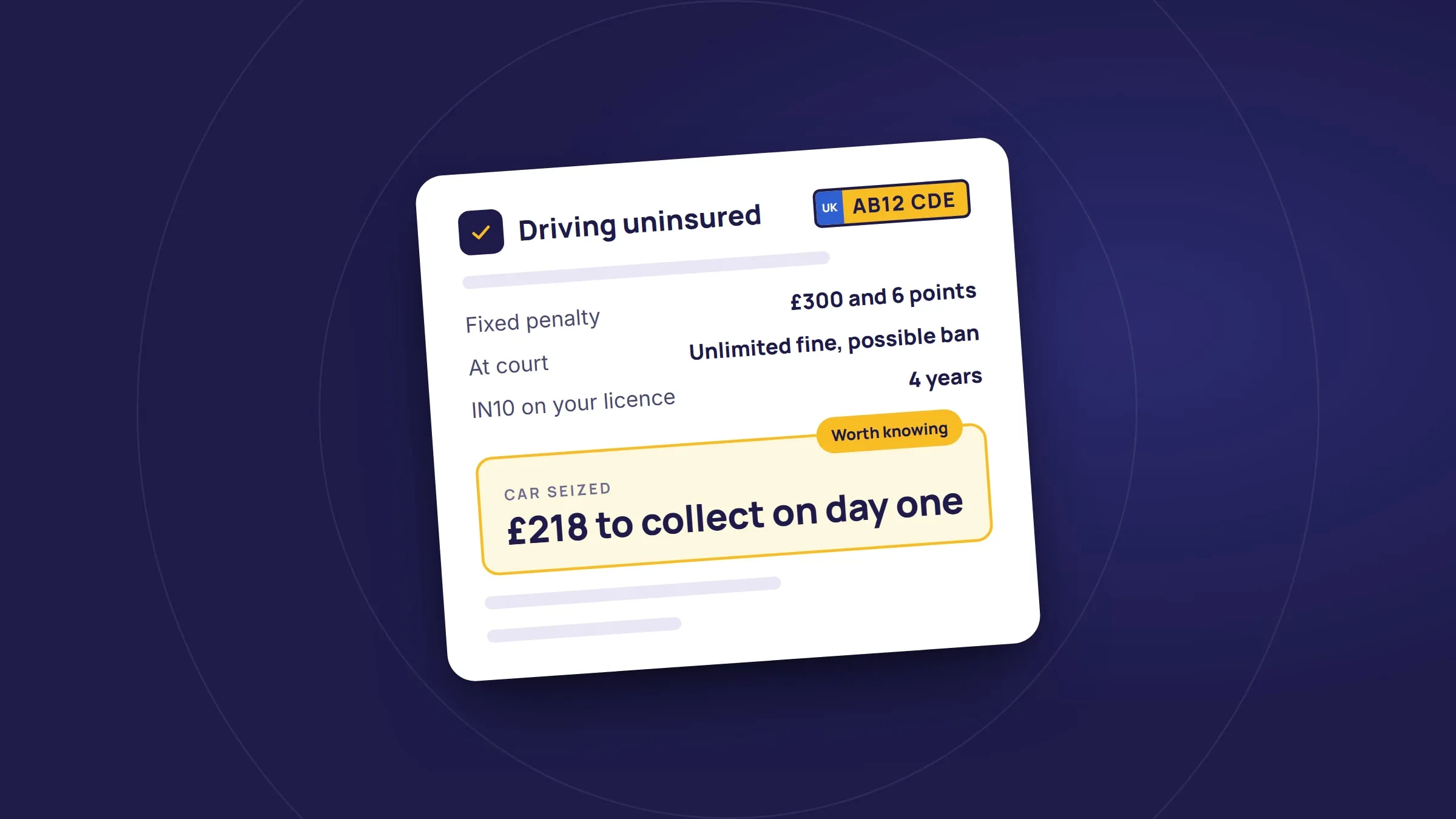
At the roadside, a fixed penalty of £300 and 6 points, or a summons to court. The car can be seized there and then. The offence code IN10 goes on your licence for four years.
GOV.UK sets out the penalties, and the sequence usually runs like this:
- The stop. A camera flags a vehicle with no record on the Motor Insurance Database, or an officer asks for the certificate after a stop for something else. You are asked to produce evidence of insurance.
- The decision. If you cannot, and the officer has reasonable grounds to believe the vehicle is uninsured, the officer can seize it under section 165A, after a warning. A fixed penalty notice may be issued at the roadside or by post.
- The penalty. £300 and 6 points by fixed penalty. Where the case is more serious, or the driver contests it, the court can impose an unlimited fine and disqualify.
- The record. IN10, “using a vehicle uninsured against third party risks”, with 6 to 8 points, stays on the licence for four years from the date of the offence.
- The car. If seized, it is in a pound and the charges are running.
Each of those has consequences of its own, and they are worth taking one at a time.
How much is the fine for driving without insurance?
£300 by fixed penalty. At court, there is no upper limit, and the court can take your licence as well.
The fixed penalty is a flat figure. A court fine is set by the sentencing guidelines against the driver’s income, and for a deliberate case, a repeat, or an uninsured driver who caused a collision, it climbs quickly. Costs and a victim surcharge are added.
The fine is also the cheap part. An IN10 makes the next insurance quote expensive, and most insurers ask about convictions for five years, one year longer than the points stay on the record. Temporary insurance for convicted drivers exists because of this: a driver with an IN10 who needs a car for a week finds the annual market closed or priced out, and a short policy is one route where an insurer’s points limit allows it.
How many points do you get for driving without insurance?
6 by fixed penalty, and 6 to 8 if the court decides. Reaching 12 in three years brings a totting-up ban, and 6 in the first two years after passing cancels a new driver’s licence.
Six points is half of the twelve that trigger a minimum six-month ban under the totting-up rules, so a driver who already carries a speeding endorsement or two is one uninsured journey from losing the licence.
For a new driver the arithmetic is shorter. Under the new driver rules, six or more points within two years of passing revokes the licence. The driver goes back to a provisional, must pass the theory and practical tests again, and carries the IN10 into the insurance they then try to buy at 18 or 19. A single uninsured journey in a borrowed car is the most common way it happens, which is why the fully comprehensive question matters so much to young drivers.
Can the police seize your car for no insurance?
Yes, at the roadside, and they do. Getting it back costs £192 plus £26 for each day or part day it is held, and the pound will only release it against a policy that covers the vehicle.
Section 165A of the Road Traffic Act 1988 lets a constable seize a vehicle where the driver fails to produce evidence of insurance and the officer has reasonable grounds to believe the vehicle is uninsured. The officer must warn the driver first, unless that is impracticable. A certificate on a phone screen, showing the vehicle and a start time before the stop, is the evidence that stops the seizure.
Once seized, the vehicle goes to a pound run for the police, and the Retention and Disposal of Seized Motor Vehicles Regulations 2005 take over. The registered keeper gets a notice and not less than 7 days to claim the vehicle. Release needs proof of ownership, identity, a driving licence and a certificate of insurance that covers the vehicle, plus the charges: £192 for removal and £26 for each 24 hours or part of it. After 7 days from the seizure (14 for vehicles seized before 22 July 2026) the vehicle can be disposed of, with a £96 charge, and many are. The step-by-step is in car seized for no insurance: how to get it back.
Most annual policies exclude seized vehicles, so the certificate the pound wants is usually a separate impound release policy: 30 days, third party only, in the keeper’s name.
Need cover before the car moves again? Enter the reg and the certificate arrives in minutes.
Get QuotesWhat counts as driving without insurance?
Any use of a vehicle on a road or public place without a policy that covers that driver for that vehicle for that use. The driver’s belief that they were covered is no defence.
Section 143 does not ask whether you meant it. The cases that fill the courts are rarely people who set out to drive uninsured:
- The lapsed policy. A missed direct debit, a card that expired at renewal, a renewal that was quoted but never confirmed. The insurer writes, the letter is unread, the policy ends.
- The voided policy. An answer on the application that was not true, such as an undeclared conviction, a wrong address, or a parent named as main driver on a child’s car. The insurer voids the policy from the start, which means in law there never was one.
- The borrowed car. Driving a friend’s car in the belief that fully comprehensive cover on your own car extends to it. It usually does not.
- The wrong use. Delivering food on a social policy, or carrying passengers for payment. The policy exists, but not for that use, and the insurer treats the journey as uninsured.
- The learner without the right cover. A provisional licence holder driving a parent’s car without a learner policy or being named on the parent’s policy as a learner.
A court can give credit where a driver genuinely and reasonably believed they were insured, and the defence of special reasons exists for the narrow case of being misled, but the conviction is the starting point in all of them.
What happens to the owner of the car?
The owner who lets someone drive uninsured commits the offence of causing or permitting, with the same penalties. The keeper of a taxed but uninsured car is fined even if it never moves.
Section 143 catches the person who “causes or permits” the use as well as the driver. A parent who hands over the keys to a child who is not on the policy, or an owner who lends a car to a friend who says they are “fully comp”, is exposed to the same £300 and 6 points.
Separately, the keeper of any vehicle that is taxed and not declared off the road must keep it insured under Continuous Insurance Enforcement. Every month the DVLA and the Motor Insurers’ Bureau compare records and write to keepers of vehicles that are taxed, not on a SORN and not showing as insured. Ignore the letter and it is a £100 fixed penalty, clamping or impounding, and a court fine of up to £1,000, for a car that may not have left the drive.
What happens if an uninsured driver causes an accident?
The victim is compensated by the Motor Insurers’ Bureau, and the Bureau can recover what it paid from the uninsured driver. The driver owes it personally.
Everyone who buys motor insurance in the UK pays a levy that funds the Motor Insurers’ Bureau, which compensates drivers, passengers, pedestrians and property owners hurt or damaged by uninsured and untraced drivers. That protects the victim. It does not protect the driver: the Bureau can pursue the uninsured driver for the money, and a serious injury claim runs to hundreds of thousands of pounds, with no insurer standing between the driver and the debt.
That is the figure to hold in mind when a day of cover starts from £21.87. Temporary car insurance from 1 hour to 28 days exists precisely for the journeys that produce most IN10s: the borrowed car, the car just bought, the week between policies.
How to make sure you are insured before you drive
Read the certificate, check the dates and the registration, and if your name is not on a policy that covers that car for that use, buy one before you turn the key.
- The certificate names the car, the policyholder and the drivers or classes of driver. Match all three to the journey.
- Check the start and end dates, including the time of day on a short policy.
- Check the use. Social, commuting, business, hire and reward are different things.
- A borrowed car needs a policy in your name, or your name on the owner’s policy. Comprehensive cover on your own car is not that.
- Keep the documents on your phone. A roadside check that finds no record is answered with the certificate.
The whole check takes a minute, and the cost of skipping it starts at £300 and does not stop there.