
In this guide 9 sections
- 1 My car has been seized for no insurance. What do I do first?
- 2 What does the pound need before it will release the car?
- 3 Will my normal insurance get the car out?
- 4 How much does it cost to get a seized car back?
- 5 Can I get my car out of the pound for free?
- 6 Who can collect the car?
- 7 What happens if I do not collect the car in time?
- 8 Will I still be prosecuted?
- 9 The sequence, in order
A seized car is a problem with a clock on it. The charges start the moment the recovery truck arrives, the right to claim it runs out in days, and the right to sell it arrives in a fortnight. Everything below is in the order it needs doing, because the order is where the money goes.
My car has been seized for no insurance. What do I do first?
Read the seizure notice. It says where the car is, who to contact, and the deadline to claim it. Then sort the insurance, because nothing else at the pound happens without it. What each force publishes about its pounds, release stations and the insurance it will accept is gathered in the vehicle pound directory.
Under section 165A of the Road Traffic Act 1988, a constable who seizes a vehicle must give the driver a seizure notice, and the Retention and Disposal of Seized Motor Vehicles Regulations 2005 require a notice to the registered keeper and the owner as well. The notice tells you:
- where the vehicle was seized and where it is being kept,
- that the keeper has not less than 7 days from the day the notice is given to claim it (7 working days for vehicles seized before 22 July 2026),
- what has to be produced to get it released,
- and that it can be disposed of if it is not claimed.
If you were the driver, you have the notice in your hand. If you are the keeper and someone else was driving, it arrives by post to the address on the V5C, which is one reason to keep that address current.
What does the pound need before it will release the car?
Four things and a payment: proof you are the keeper or owner, photo identity, a driving licence valid for the vehicle, a certificate of insurance covering your use of that vehicle, and the charges.
Regulation 5 sets the list. In practice the pound checks:
| What | What satisfies it |
|---|---|
| Ownership | The V5C log book in your name, or a bill of sale and the new keeper slip for a car just bought |
| Identity | Passport or photocard licence, with proof of address if the name on the V5C does not match |
| Licence | A licence that entitles you to drive that class of vehicle |
| Insurance | A certificate of motor insurance that covers you to use that vehicle |
| Charges | Removal and storage, paid at the pound, usually by card |
The insurance line is where most people get stuck. The pound will not accept a cover note that does not name the vehicle, a driving other cars extension on someone else’s policy, or a policy whose wording excludes seized vehicles. Staff see a lot of certificates and know which insurers exclude impounded cars. Most do.
Will my normal insurance get the car out?
Usually not. Most annual policies exclude vehicles seized by the police, and a policy bought after the seizure on the standard product is often refused for the same reason. Impound release insurance exists for this.
An insurer that writes a standard policy has not priced a driver who has just been stopped for having no insurance, and most exclude seized vehicles in the wording. Some annual insurers will issue a policy; many will not, and the pound decides what it accepts. The day spent finding out is £26.
Impound release insurance is written for the insurance condition a pound sets before it releases a vehicle. The policy runs for 30 days only, is third party only, cannot be amended after purchase, and is issued in the registered keeper’s name, or the lessee’s with the lease as evidence. For a car the driver must hold a full UK, EU or international licence and be aged 21 to 69; a keeper on a provisional licence aged 17 to 69 can be covered with a named full-licence driver over 30 to drive it home, and a named driver can also be added where the keeper is banned. For a van the driver is 25 to 69. A pending uninsured-driving conviction is acceptable provided the licence is not suspended. The vehicle needs a valid MOT, or a pre-booked test, and tax.
The certificate arrives by email as soon as you pay. Whether the pound accepts it on a phone is for the pound to say, so check before you go.
Seized car? A 30-day impound release policy in the keeper’s name.
Get QuotesHow much does it cost to get a seized car back?
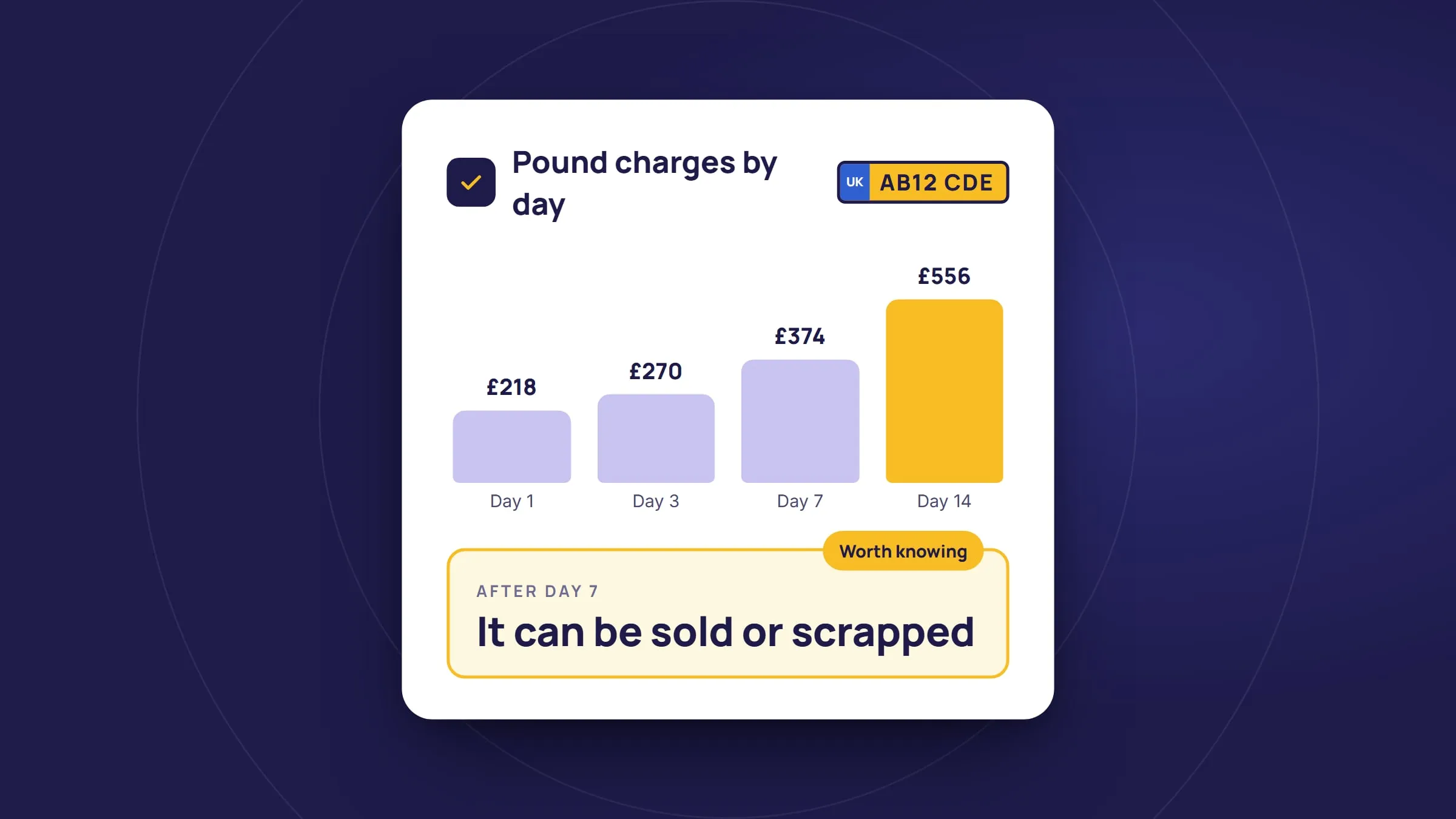
£192 for removal and £26 for each day or part day in storage, in England and Wales. Day one is £218, a week is £374, a fortnight is £556, before insurance.
| Collected on | Removal | Storage | Total before insurance |
|---|---|---|---|
| Day 1 | £192 | £26 | £218 |
| Day 3 | £192 | £78 | £270 |
| Day 7 | £192 | £182 | £374 |
| Day 14 | £192 | £364 | £556 |
Storage is charged for each period of 24 hours or part of one, so a car collected an hour into day three pays three days. The removal charge is higher where the vehicle was off the road, damaged or had to be winched, and heavier vehicles carry higher rates. If the vehicle is never claimed and is disposed of, a £96 disposal charge is added and the keeper remains liable for the lot.
The impound policy is on top: from £360, on the broker’s published prices, and a 17-year-old keeper on a provisional licence with a named driver will see more.
Can I get my car out of the pound for free?
Only if you can show it was taken and driven without your knowledge or consent. Otherwise the charges are payable by whoever collects it, whatever happens to the case.
Regulation 5 exempts a keeper or owner from the charges where they did not know the vehicle was being driven and did not consent to it, which is the stolen-car case. A police crime reference and the timeline do the work there. For everyone else, the charges are a condition of release, not a penalty that depends on guilt. Winning the court case later does not refund them.
If the car is worth less than the bill to recover it, which happens with older cars left in the pound for a week, telling the pound in writing that you will not be claiming it at least stops the storage clock. The disposal charge still applies.
Who can collect the car?
The registered keeper or owner, or someone they nominate who brings their own licence and a certificate that covers them to drive that vehicle.
The nomination route is how three common cases get solved:
- The keeper is banned. The impound policy is in the keeper’s name with a named driver, who drives it out.
- The keeper has a provisional licence. The same, with the named driver over 30 on the policy.
- The keeper cannot get there. A friend or relative collects with a letter of authority, the keeper’s proof of ownership and identity, and a certificate in their own name for the car.
In each case the person behind the wheel leaving the pound must be insured to drive that car at that moment. A second seizure on the forecourt is not unknown.
What happens if I do not collect the car in time?
After the claim period on the notice and 7 days from the seizure, it can be sold or scrapped, with a £96 disposal charge, and you still owe the money. For vehicles seized before 22 July 2026 the period is 14 days.
Regulation 7 sets the earliest disposal at 7 days from the seizure, and only where the keeper has not complied with the notice. That was 14 days until the Timeframes (Amendment) Regulations 2026 took effect on 22 July 2026; the shorter period applies to any vehicle seized from that date. Pounds hold vehicles a little longer in practice, but the right exists and auctions run weekly. Any sale proceeds go against the charges first.
The deadlines interact with the insurance step. Seven days sounds like time; a weekend inside it, plus a day lost to an insurer that will not quote, is how people miss it.
Will I still be prosecuted?
Yes. Getting the car back and the offence are separate. The fixed penalty or court case continues, and driving home without cover for that journey is a second offence.
GOV.UK sets out the penalties: a fixed penalty of £300 and 6 points, or an unlimited fine and possible disqualification at court, and an IN10 on the licence for four years. What happens if you drive without insurance covers the rest, including the new driver rule that revokes a licence at 6 points in the first two years.
The one thing in your control is not adding to it. The impound policy covers the 30 days from the time it starts; the drive home is inside that, and so is the time to find an annual policy or declare the car off the road. Once the 30 days end, a taxed car with no policy is a Continuous Insurance Enforcement letter waiting to happen, and the next camera is the next seizure.
The sequence, in order
Notice, insurance, documents, money, collect, then sort what comes next. Each day of delay is £26.
- Read the notice. Pound address, contact number, deadline.
- Buy the policy. Impound release, in the keeper’s name, with a named driver if the keeper cannot drive. Certificate by email in minutes.
- Gather the documents. V5C or bill of sale, photo identity, licence, the certificate, proof of address if needed.
- Go, with a card. Pay the removal and storage charges. Check the vehicle for damage before you sign for it, and note anything on the release form.
- Drive out insured. The policy start time must be before you leave the pound.
- Use the 30 days. Annual policy or SORN before the impound policy ends, and tax if the seizure revealed it had lapsed.
Done on day one, the whole thing costs the charges, the policy and a morning. Left for a week, it can cost the car.