
In this guide 7 sections
- 1 Can you tax a car with temporary insurance?
- 2 What do you need to tax a car?
- 3 I have just bought a car. What order do I do things in?
- 4 Can I tax a car that is on a SORN with temporary insurance?
- 5 What happens when the temporary policy ends and the car is still taxed?
- 6 Can I tax a car without insurance at all?
- 7 Does it work the same for vans, motorhomes and learners?
The question usually arrives with a car attached: one that has just been bought, one that has been sitting on a drive on a SORN, or one whose annual policy has lapsed and whose keeper wants to move it before sorting something longer. In every case the answer to the question as asked is yes. The useful part is the sequence, because tax, MOT and insurance each have a rule about the others, and doing them in the wrong order either costs money or leaves the car uninsured.
Can you tax a car with temporary insurance?
Yes. In Great Britain insurance is not checked when you tax a car at all, and in Northern Ireland a temporary policy’s certificate is accepted like any other.
Until December 2013 the DVLA asked for an insurance certificate before it would tax a vehicle. It stopped once Continuous Insurance Enforcement had bedded in, which replaced the one-off check at the counter with a monthly comparison of the whole tax record against the whole insurance record. So taxing a vehicle on GOV.UK now asks for the reference number from the log book or the new keeper slip, a payment card, and nothing about insurance. The same is true by phone and at a Post Office in England, Scotland and Wales.
Northern Ireland kept the counter check. To tax at a Post Office there you need a paper copy of an insurance certificate or cover note and the original MOT certificate. A temporary policy issues a certificate within minutes of purchase, so print it and it does the job. The policy has to be in force on the day.
Whether a temporary policy is the right thing to be holding when the tax runs for twelve months is a different question, and the rest of this guide is about that.
What do you need to tax a car?
A reference number, a valid MOT, and a way to pay. The reference comes from the V5C log book, the green new keeper slip, or the V11 reminder.
| Document | Reference | When you use it |
|---|---|---|
| V5C log book in your name | 11-digit number | A car you already keep |
| Green new keeper slip (V5C/2) | 12-digit number | A car you have just bought, before the log book arrives |
| V11 reminder letter | 16-digit number | A renewal |
The MOT must be valid on the day the tax starts, unless the vehicle is exempt. The DVLA checks that itself, so a car with no MOT cannot be taxed online or at a counter until it has passed. Direct debit, a card and the Post Office all work; the tax starts from the first of the month you choose, or at once.
I have just bought a car. What order do I do things in?
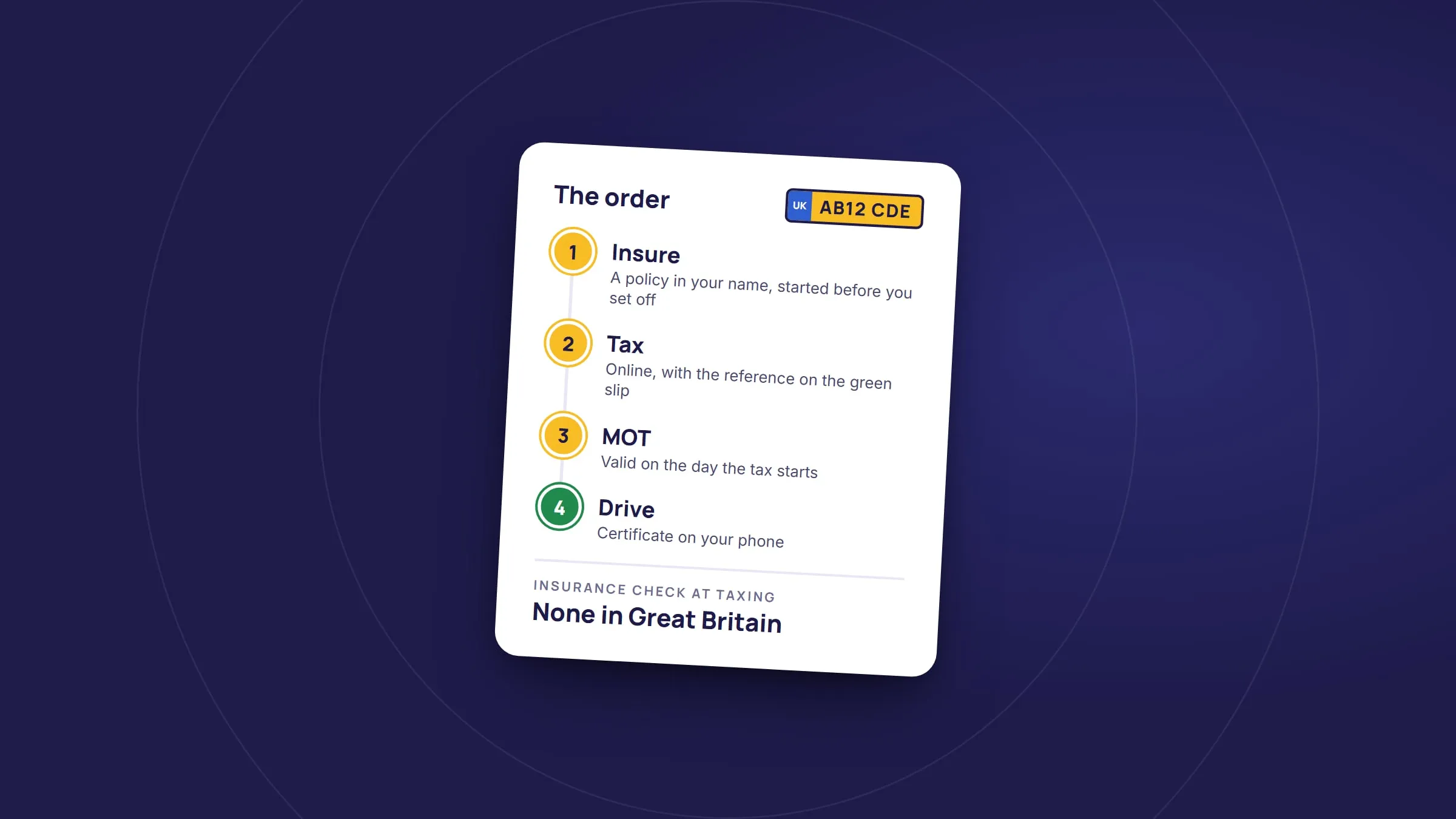
Insure it, tax it, then drive it. Both can be done on a phone at the seller’s door, and neither transfers from the seller.
Since October 2014 vehicle tax has ended at the point of sale. The seller is refunded any full months and the buyer starts again, which is why a car with “six months’ tax” in an advert has none for the person buying it. The sequence that keeps everyone legal is:
- Buy the cover. A drive away policy in your name, starting before you set off, with the car’s registration on the certificate. Temporary cover runs from 1 hour to 28 days, is comprehensive as standard, and leaves you time to shop for an annual policy without the car sitting uninsured.
- Tax the car. Online with the 12-digit reference on the green slip the seller tears from the log book. It takes a few minutes and is live at once.
- Drive. Carry the certificate on your phone. The insurance record reaches the Motor Insurance Database after the broker’s next upload, and the certificate is the legal proof until then.
There is no grace period for either. A car driven home untaxed can be clamped or fined; a car driven home uninsured can be seized, and GOV.UK sets out the penalties: £300 and 6 points by fixed penalty, or an unlimited fine and possible disqualification at court.
Collecting a car this week? Cover starts from the time you choose.
Get QuotesCan I tax a car that is on a SORN with temporary insurance?
Yes, and taxing it ends the SORN. The order to do it in is tax first, then insurance, then drive, because the broker will not cover a car still on a SORN.
A Statutory Off Road Notification tells the DVLA the car is off the road, which removes the duty to tax and insure it. Taxing the car cancels the SORN automatically, and in Great Britain no insurance is needed to do that.
The insurance side has its own rule. The broker that quotes on this site excludes vehicles on a SORN, with one exception: driving to a pre-booked MOT. So for a car that has been off the road:
- It has a valid MOT. Tax it online, which ends the SORN. Then buy the temporary policy, then drive.
- It has no MOT. The DVLA will not tax it until it passes. Book the test, buy a temporary policy for the journey, which is the exception the broker allows and the exception the law allows for driving a SORN car, then tax it once it has passed.
GOV.UK’s SORN guidance is firm on the limit: a SORN vehicle may be driven to or from a pre-booked MOT and for no other purpose, and using it on the road otherwise is a court matter with a fine of up to £2,500. The insurance requirement never lifts, even for the MOT journey.
What happens when the temporary policy ends and the car is still taxed?
The car becomes taxed and uninsured, which is an offence for the keeper whether or not it moves. Either buy the next policy before the first ends, or put the car back on a SORN.
This is the part that catches people. Under Continuous Insurance Enforcement a vehicle that is taxed must be insured, full stop. Every month the DVLA and the Motor Insurers’ Bureau compare the records and write to the keeper of any vehicle that is taxed, not on a SORN and not showing as insured. The letter is a warning. After it, the keeper can be fined £100 by fixed penalty, the vehicle can be clamped, impounded or destroyed, and the court maximum is £1,000.
A 28-day policy, the longest a single temporary policy runs, is long enough to tax a car and find an annual policy. If the plan is to keep the car off the road again afterwards, make a new SORN before the policy ends; any full months of tax are refunded, and the monthly comparison finds nothing to write about. The DVLA refunds tax when a SORN is made, so there is no financial reason to leave a car taxed and uninsured.
Can I tax a car without insurance at all?
In Great Britain, yes, as a transaction. As a state of affairs, no: a taxed car must be insured or on a SORN from the day the tax starts.
The distinction matters because people hear “no insurance check” and plan around it. The check moved; it did not disappear. A car taxed on a Monday with no policy will be on the next monthly comparison, and the keeper will get the letter.
The one lawful route to a taxed, uninsured vehicle is a trade licence, which is for motor traders and testers and is not available to a private keeper.
Does it work the same for vans, motorhomes and learners?
Yes. Tax is tax, and the rules above apply to any vehicle. The insurance rules differ by product, so check that the temporary policy can be used on the vehicle first.
The broker quoted here covers vans up to 3.5 tonnes and motorhomes with fixed living facilities on their own products, each with its own age limits and exclusions, and the SORN rule is the same across them. A learner driver policy sits on top of an existing annual policy, so the car it covers is already insured and taxed by its owner.
Whatever the vehicle, the sequence is the same four words: insured, taxed, MOT, drive. The temporary policy covers the first; the DVLA’s website covers the second in the time it takes to find the green slip.