
In this guide 9 sections
- 1 How long does insurance take to show on the MID?
- 2 What is the MID?
- 3 Does temporary car insurance show on the MID?
- 4 How to check if a car is insured on askMID
- 5 Why is my car showing as uninsured on the MID?
- 6 What happens if the police stop me before it updates?
- 7 What are the penalties if I really am uninsured?
- 8 Can I tax a car before the insurance shows on the MID?
- 9 What the MID is not
The MID is a record, not the insurance. The policy exists the moment the insurer issues it, and the certificate is what the law asks a driver to produce. The database catches up on its own timetable, and this guide sets out what that timetable is, how to check it, and what to do when a car you know is insured still shows as uninsured.
How long does insurance take to show on the MID?
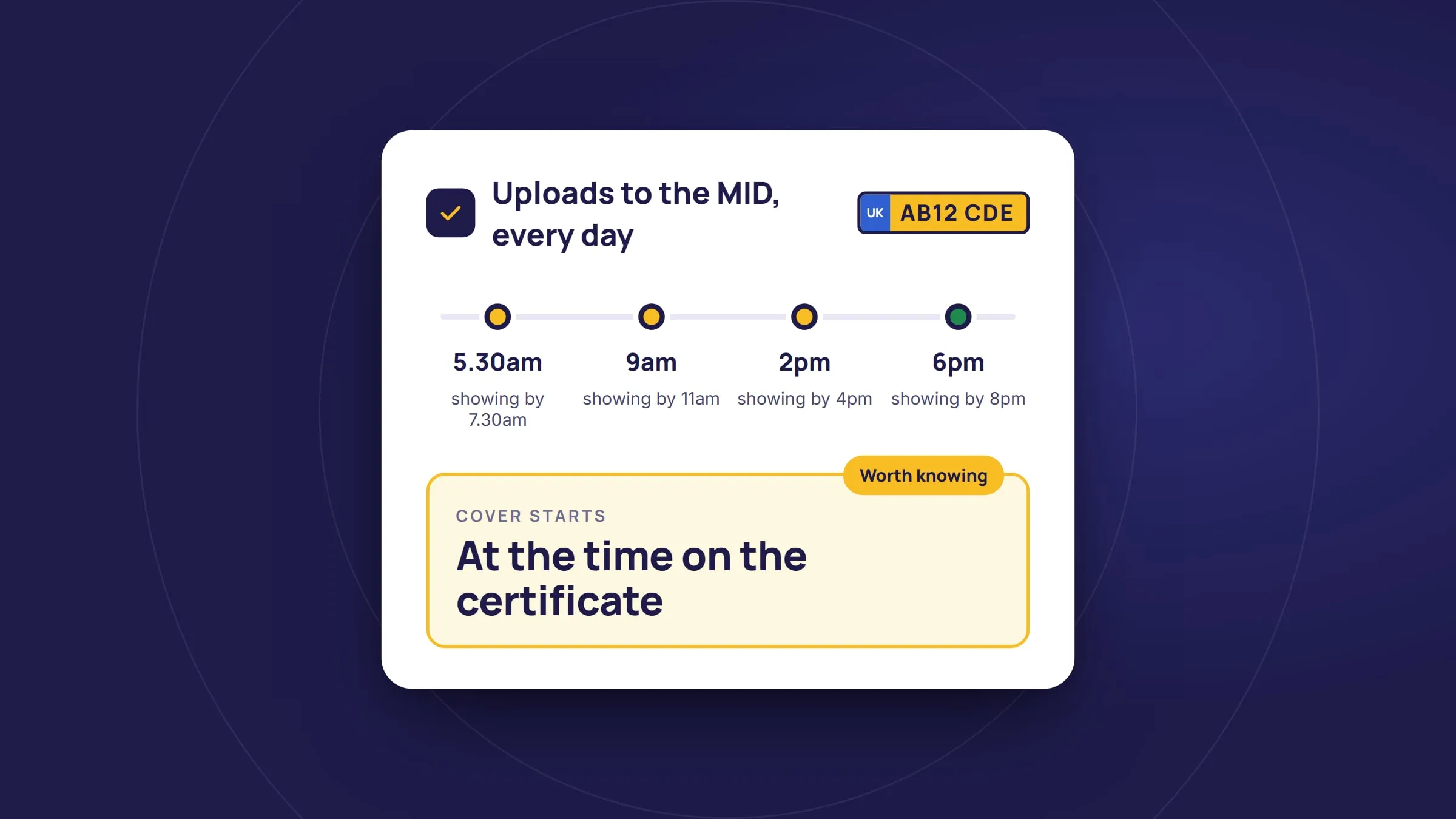
Up to seven days for an annual policy, usually a day or two in practice. Temporary policies from the broker are uploaded at 5.30am, 9am, 2pm and 6pm every day and show after the next upload.
| Policy | Typical time to show | Longest you should wait |
|---|---|---|
| Temporary policy from the broker | After the next upload | About 13 hours, if bought just after the 6pm upload |
| Annual policy from a large insurer | 24 to 48 hours | 7 days |
| Mid-term change, such as a new registration | A few days | 7 days from the change |
| Fleet and trade policies | Up to 7 days for the policy, longer for each vehicle | 21 days for vehicle records |
The seven-day figure is not a guess. From 1 January 2008 insurers have been required to load 95% of private car policies within seven days of the start date. The Motor Insurers’ Bureau, which runs the database, tells drivers to run another search after seven days and to contact the insurer if the vehicle still shows as uninsured.
Temporary cover is quicker because the broker sends records in scheduled batches rather than overnight runs. A policy bought at 10am goes up in the 2pm batch. A policy bought at 6.15pm misses the evening batch and goes up at 5.30am the next morning, so the worst case is a little over 13 hours. The policy itself started at 6.15pm.
What is the MID?
The Motor Insurance Database is the central record of every insured vehicle in the UK, run by the Motor Insurers’ Bureau and read by the police and the DVLA.
Every insurer that writes UK motor cover must send its policies to the database. The police use it at the roadside and through automatic number plate recognition cameras, the DVLA uses it to find taxed vehicles with no insurance, and the public can check a registration on it for free.
Three names come up and they are easy to confuse:
- The MID is the database itself.
- askMID is the public website for checking a registration. It has been the address since 2005 and still works.
- Navigate is the platform the Bureau moved the database onto in April 2024. The free check on askMID now runs on Navigate, which is why the page you land on carries that name.
Nothing changed for drivers when the database moved. The check is still free, still instant and still only tells you whether a vehicle is showing as insured today.
Does temporary car insurance show on the MID?
Yes. A temporary policy is a full policy with its own number and certificate, and it is reported to the database in the same way as an annual one.
What differs is the clock. Annual insurers tend to send records in overnight or weekday batches. The broker sends policy details to the database four times a day, every day of the year, and the record follows the upload.
| Policy bought between | Goes up in the |
|---|---|
| 6pm and 5.30am | 5.30am upload |
| 5.30am and 9am | 9am upload |
| 9am and 2pm | 2pm upload |
| 2pm and 6pm | 6pm upload |
The emailed documents arrive as soon as you pay, long before the database update. For a one-day policy or an hourly policy the cover may be over before the record is visible, and that is not a problem for the driver: the certificate carried the cover, and the record is for the police and the DVLA afterwards.
Enter the reg and the certificate arrives by email as soon as you pay.
Get QuotesHow to check if a car is insured on askMID
Go to askMID.com, choose the free personal check, accept the terms and enter the registration. The answer is immediate.
- Open askMID.com and choose the free check for your own vehicle.
- Read and accept the terms. They say the check is for the vehicle you own or are insured to drive.
- Enter the registration exactly as it appears on the certificate.
- Read the result. It says whether the vehicle is showing as insured on the database today.
The free check does not name the insurer and does not say who is insured to drive the vehicle. A car can show as insured while the person behind the wheel has no cover at all, which is why the police check the driver as well as the plate.
After a collision you can find the other vehicle’s insurer through the Other Vehicle Lookup on the same site. It asks for the date and circumstances of the accident, charges £10 and returns the insurer’s name and policy number for a claim.
Why is my car showing as uninsured on the MID?
Usually because the policy is new and the insurer has not sent it yet, or because the registration on the policy does not match the plate.
Work through these in order before contacting anyone:
- The policy started recently. Give an annual policy up to seven days. A temporary policy from the broker goes up at the next scheduled upload.
- The registration is wrong on the policy. A single transposed letter puts the record against a different vehicle. Check the certificate against the plate.
- A new plate or a change of car. A mid-term change can take a few days to reach the database. The old registration drops off when the new one goes on.
- The policy was cancelled or voided. If a direct debit failed or the insurer found a mismatch on the application, the policy may have ended without you noticing. Check the emails from the insurer.
- The previous policy has ended and the new one has not started. Renewals that lapse for a day leave a gap on the database.
- The vehicle is on a SORN. A vehicle declared off the road does not need insurance and will show as uninsured. That is correct, until the day it goes back on the road.
If none of those explains it after seven days, contact the insurer or the broker that sold the policy and ask them to confirm the record has gone to the database. They can resend it. The Bureau cannot change the record for you, because only the insurer that holds the policy can.
What happens if the police stop me before it updates?
A missing record is a reason for the officer to ask for evidence of insurance, not proof that there is none. Produce the certificate and the stop normally ends there.
The law works in two steps. Under section 165 of the Road Traffic Act 1988, a constable in uniform can require a driver to produce the certificate of insurance. If you do not have it with you, you can be required to produce it at a police station within 7 days. That is the paper form sometimes still called a producer.
Seizure is a separate power. Section 165A lets a constable seize a vehicle only when the driver fails to produce evidence of insurance and the officer has reasonable grounds to believe the vehicle is being driven uninsured. The officer must warn the driver first, unless that is impracticable. A certificate on a phone screen, showing the vehicle, the driver and a start time before the stop, is evidence that defeats both limbs.
So the practical advice is simple:
- Keep the emailed certificate and policy schedule on your phone, and download them rather than relying on signal at the roadside.
- Check that the start time on the certificate is before the time you set off. A policy bought in the car park after being stopped does not help.
- Offer the policy number. The officer can confirm it with the insurer, and most forces can contact insurers directly for exactly this situation.
What are the penalties if I really am uninsured?
A fixed penalty of £300 and 6 points, or an unlimited fine and possible disqualification at court, and the police can seize the vehicle.
GOV.UK sets out the penalties. Being uninsured to drive a vehicle is an offence even when the vehicle itself is insured for someone else, so a friend driving your insured car without their own cover is committing it.
A seized vehicle goes to a pound and the charges start at once. In England and Wales the removal fee is £192, storage is £26 for each day or part day, and disposal costs £96 if the vehicle is never claimed. The pound will not release the vehicle without a policy that covers collecting it, and a standard policy will not do, because most insurers exclude impounded vehicles. Impound release insurance explains the 30-day policy written for the pound’s insurance condition, and the deadlines before the vehicle can be sold.
Can I tax a car before the insurance shows on the MID?
Yes. In Great Britain the DVLA no longer checks the database when you tax a vehicle. The check happens afterwards, every month, against taxed vehicles with no insurance record.
Since 2011 the keeper of a taxed vehicle has been required to keep it insured whether or not it is driven, under Continuous Insurance Enforcement. Every month the Bureau and the DVLA compare the two databases and write to the keepers of vehicles that are taxed, not on a SORN and not showing as insured. The letter is a prompt, not a penalty. Ignoring it can lead to a fixed penalty of £100, clamping or impounding, and a court fine of up to £1,000.
A temporary policy satisfies the rule while it runs. When it ends, the vehicle needs another policy or a SORN before the next monthly comparison. In Northern Ireland the position is different: the DVA still checks insurance at the point of taxing, so the policy needs to be on the database first.
What the MID is not
The database is not the policy, not the proof, and not a list of who can drive.
It is worth being precise about this, because the fear of a roadside check drives most of the questions people ask about the MID:
- Not the policy. Cover exists from the moment the insurer issues it. A record that appears after the next upload confirms the policy; it does not create it.
- Not the legal proof. Section 165 asks for the certificate. The database is a tool the police use to decide whom to stop.
- Not a list of drivers. The record is against the vehicle. A fully comprehensive policy on one car does not mean its holder can drive another, and the database cannot tell an officer either way.
That is why the single most useful habit is also the simplest one: open the emails, check the registration and the start time on the certificate, and keep the documents on the phone. The database will catch up on its own.