
In this guide 8 sections
- 1 Can I drive any car with fully comprehensive insurance?
- 2 How do I check whether my policy includes driving other cars?
- 3 What conditions usually apply?
- 4 Does driving other cars cover named drivers or young drivers?
- 5 When is driving other cars cover enough, and when is it not?
- 6 Does driving other cars let me drive a van, a hire car or an impounded car?
- 7 What happens if I drive another car and the extension is not there?
- 8 The one-minute check before you borrow a car
The belief is old and stubborn: fully comprehensive means covered for anything, including any car. It was closer to true twenty years ago, when most comprehensive policies carried a line allowing the policyholder to drive other cars. Insurers have been quietly removing it, restricting it to older drivers, or keeping it third party only. The result is that a driver who was covered to move a friend’s car in 2005 may not be today, and the only way to know is to read the certificate.
Can I drive any car with fully comprehensive insurance?
No. Comprehensive describes the level of cover on your own car. Driving a different car needs the driving other cars extension, and that is a separate line on the certificate that many policies no longer carry.
Three things get confused here, so it helps to separate them:
- The level of cover. Third party only, third party fire and theft, or comprehensive. This says what the insurer pays for on the car named in the policy.
- The drivers. The policyholder and anyone named. This says who can drive the car named in the policy.
- The driving other cars extension. A separate permission, where it exists, for the policyholder to drive a car that is not theirs. This is the only part of the policy that says anything about other cars.
A comprehensive policy with no extension covers you to drive one car: yours. Get into a friend’s car and you are, in the eyes of section 143 of the Road Traffic Act, a person using a motor vehicle without insurance.
How do I check whether my policy includes driving other cars?
Read the certificate of motor insurance. Under the limitations as to use, or the persons or classes of persons entitled to drive, the extension is either written out or absent.
The certificate is the legal document, and it is short. The wording varies by insurer but follows a pattern: “The policyholder may also drive a motor car not belonging to him or her and not hired to him or her under a hire purchase agreement, provided that the policyholder holds a valid licence”. Some add “and is aged 25 or over”, or “with the owner’s permission”, or “where there is no other insurance in force”.
Where the certificate is silent, the policy booklet does not rescue you. The booklet describes what the insurer might offer; the certificate records what you bought. If you cannot find the certificate, the insurer’s app or online account has it, and a phone call to the insurer with your policy number settles it in a minute. Do not rely on a comparison site’s summary or on what the policy said last year.
What conditions usually apply?
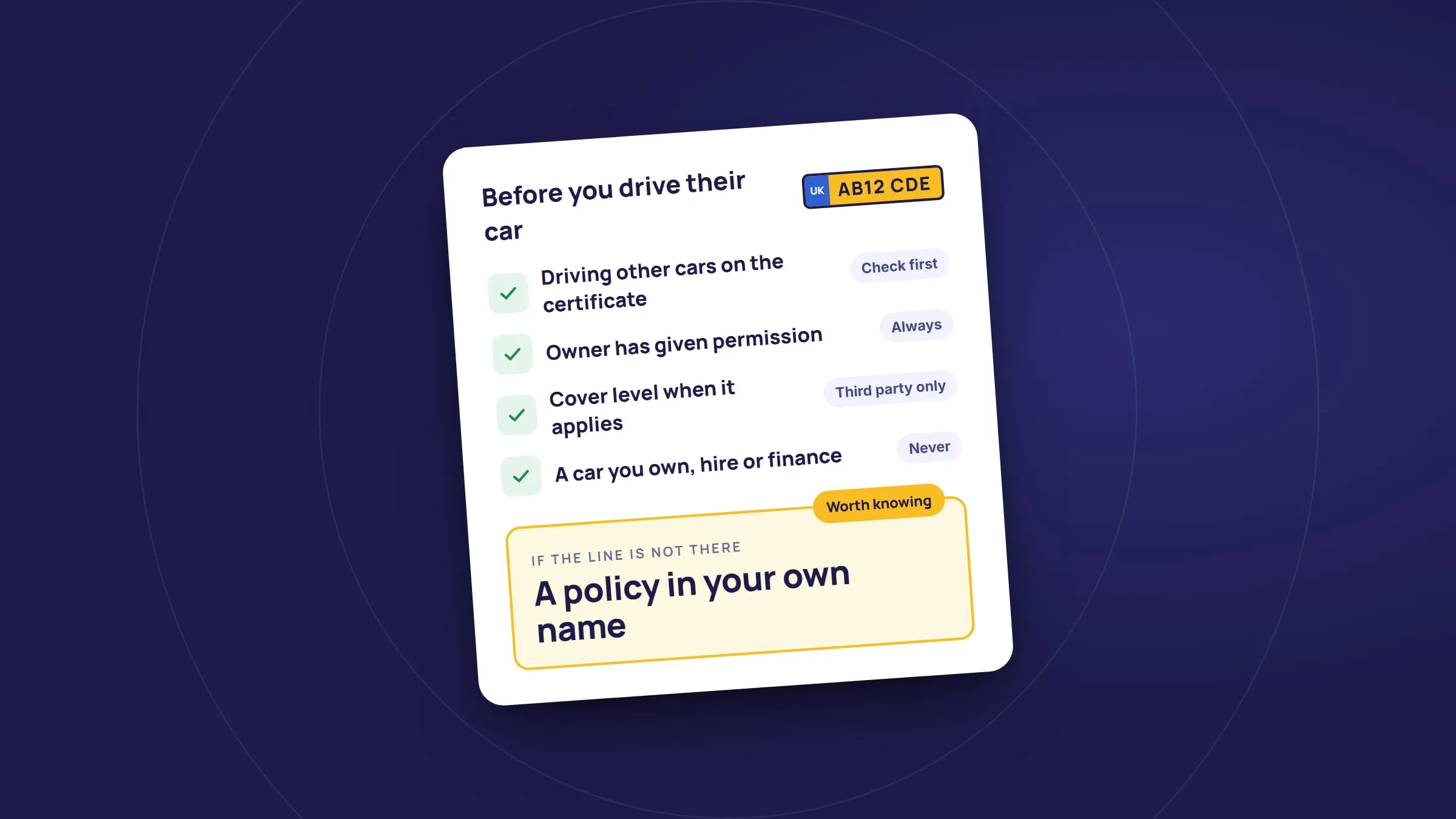
The policyholder only, usually over 25, with a full licence, the owner’s permission, and a car that is not yours, not hired and not on finance. Cover is third party only.
| Condition | Usual rule |
|---|---|
| Who | The policyholder, not named drivers |
| Age | Often 25 or over, sometimes 21 |
| The car | Not owned, hired, leased or financed by you; private car, not a van |
| Permission | The owner’s, and some insurers require the car to be insured by someone else |
| Cover | Third party only: other people and their property, not the car you are in |
| Use | Social; some wordings say emergency use only |
The third party point is the one that catches people. A borrowed car scraped against a post is damage to the car you are driving, and the extension does not pay for it. The owner’s policy will not pay either, because you were not on it. The owner is left with a bill, and the friendship with a problem.
Does driving other cars cover named drivers or young drivers?
Usually neither. The extension belongs to the policyholder, and most insurers withhold it from drivers under 25.
A named driver on a parent’s policy has permission to drive that car. Nothing about the parent’s driving other cars line passes to them. Young drivers, the group most likely to borrow a car, are the group least likely to have the extension at all, because insurers price it as a risk and remove it from the policies where that risk is highest.
For a 21-year-old wanting to drive a friend’s car, one route is a temporary policy in their own name: comprehensive as standard, 1 hour to 28 days, with the owner’s permission and the insurer’s criteria met. The broker’s panel covers drivers aged 17 to 75 with a full UK licence, on cars worth between £500 and £65,000 with a valid MOT and not on a SORN, with the minimum age, the licence types accepted and the value band varying by insurer. The insurer may also require the licence to have been held for 6 months, or 3 months if over 25, and no more than 2 claims and 6 points in the last 3 years.
Borrowing a car and no driving other cars line on your certificate? A policy in your own name starts from one hour.
Get QuotesWhen is driving other cars cover enough, and when is it not?
Enough for moving a car a short distance in an emergency. Not enough for a weekend, a long drive, a valuable car, or anything you would mind paying for yourself.
The extension exists for the moment a friend has been taken ill and their car is blocking an ambulance, or a relative’s car must be moved for the bin lorry. Third party only is fine for a hundred yards. It is a poor way to drive a borrowed car to the coast, because anything that happens to the car is your bill, and the insurer that wrote the extension expected you to use it rarely.
For anything else, two routes:
- A temporary policy in your name. Standalone, comprehensive, with its own certificate and policy number. The owner’s no claims discount is untouched by anything that happens on it. From 1 hour to 28 days.
- Named driver on the owner’s policy. Suited to months rather than days, with the trade-off that a claim with you at the wheel lands on the owner’s record and premium.
There is a third, which is a courtesy or lent car from a garage or dealer while yours is repaired; the same temporary product covers it with the insurers that accept a lent car, though not a hire car from a rental company.
Does driving other cars let me drive a van, a hire car or an impounded car?
No to all three. Vans and commercial vehicles are excluded, hire cars are excluded by definition, and an impounded car is excluded by almost every policy there is.
Vans are a separate class of vehicle with their own temporary van product, up to 3.5 tonnes. Hire cars come with the rental company’s insurance, or an excess product, and the extension’s own wording excludes a car “hired to you”. An impounded car is the clearest case: the pound requires a certificate of insurance that covers that vehicle, and a driving other cars line names no vehicle, so the pound will not release the car against it. Impound release insurance is the policy written for that job.
What happens if I drive another car and the extension is not there?
You are uninsured. £300 and 6 points by fixed penalty, an unlimited fine and possible disqualification at court, and the car can be seized.
GOV.UK sets out the penalties. The fact that you hold a comprehensive policy on your own car is no defence; the offence is using a vehicle you are not insured to use. The owner who lent the car can be charged with causing or permitting it. The Motor Insurance Database will show the owner’s car as insured, so the stop will not come from a number plate camera, but the first question at any roadside stop or after any collision is “are you insured to drive this car?”, and the answer has to be on a certificate with your name on it.
The one-minute check before you borrow a car
Certificate, condition, permission, cover level. If any of the four fails, buy a policy in your own name before you turn the key.
- Certificate. Open yours. Find the driving other cars line, or find that it is not there.
- Conditions. Age, licence, the car not being yours or hired, any requirement for the car to be insured by someone else.
- Permission. The owner’s, which the extension assumes and the law expects.
- Cover level. Third party only. Decide whether you are happy to pay for the borrowed car yourself if something happens.
Most people who do the check find that the honest answer to the question in the title is no, and that a policy in their own name is the fix.