
In this guide 8 sections
- 1 Can you insure a car that is not in your name?
- 2 Who are the keeper, the owner and the policyholder?
- 3 Why do insurers care whose name the car is in?
- 4 What are the ways to insure a car you do not own?
- 5 Can I be the main driver on a car in my parents’ name?
- 6 Can I insure a car that someone else has already insured?
- 7 What happens if I drive a car that is insured, but not by me?
- 8 What the owner should check before lending the car
Three names can be attached to one car, and most of the confusion in this question comes from assuming they have to be the same person. They do not. The law cares that whoever drives the car is insured to drive it. Insurers care who is likely to be driving it and who would lose money if it were damaged. Sort those two things out and the answer to almost every version of the question follows.
Can you insure a car that is not in your name?
Yes. Nothing in law requires the policyholder to be the registered keeper or the owner. Whether a particular insurer will quote is a commercial decision, and some will not.
The certificate of motor insurance names a policyholder and a vehicle. It does not ask whose name is on the log book. What an annual insurer asks on the application is who owns the car and who is its registered keeper, and the answer changes the price or ends the quote. Where the keeper is a spouse, a civil partner or a parent at the same address, most insurers carry on. Where the car belongs to a friend, an ex-partner or someone at another address, many decline, because they cannot see why you would be insuring it unless the application is hiding who really drives it.
Temporary insurance was built for the cases the annual market turns away. A policy in the driver’s name, on a car the driver does not own, with the owner’s permission, is the product itself rather than an exception to it.
Who are the keeper, the owner and the policyholder?
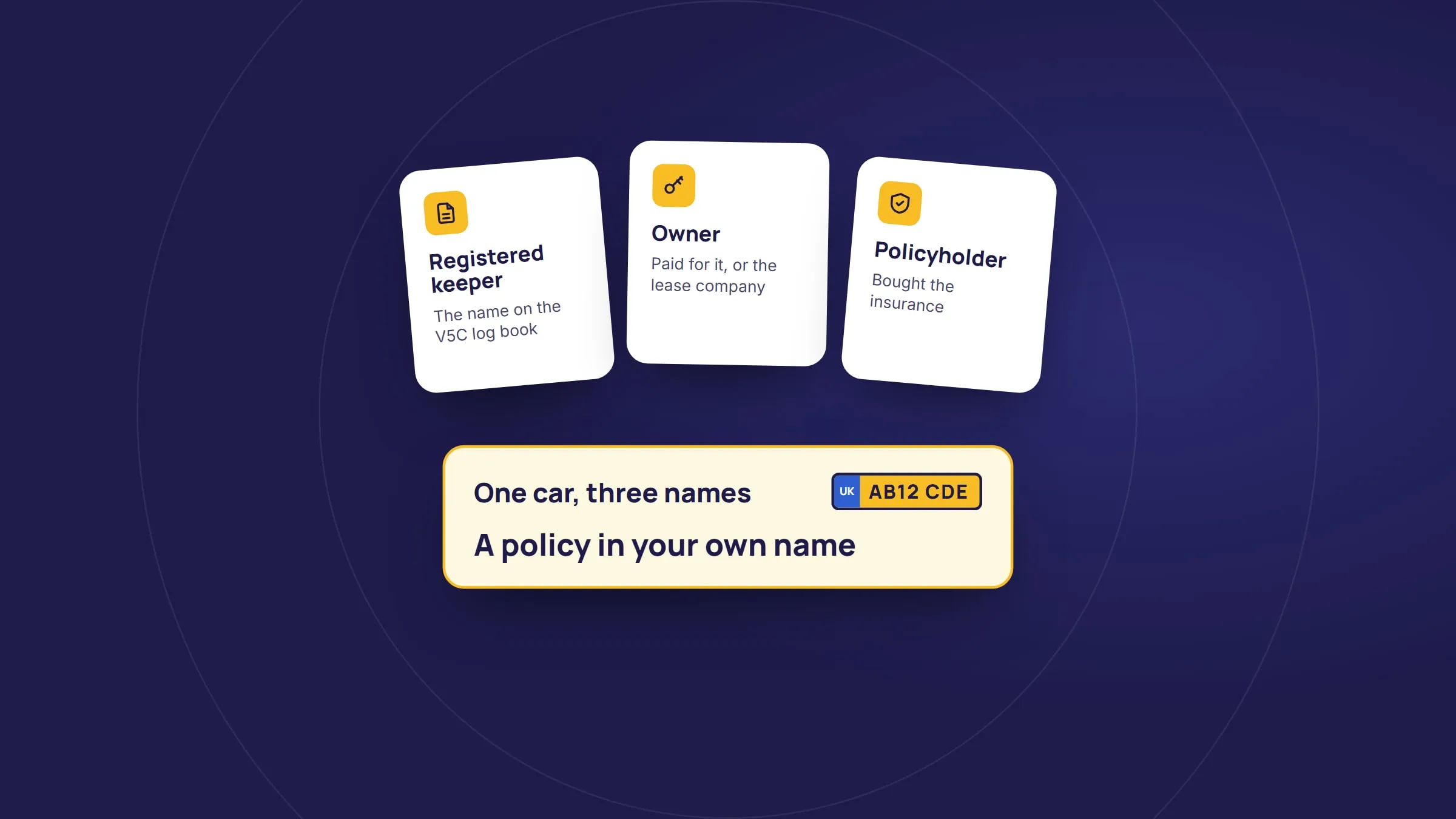
The keeper is the person on the V5C log book. The owner is whoever paid for the car or holds the finance. The policyholder is the person who bought the insurance. They can be one person or three.
| Role | Defined by | Responsible for |
|---|---|---|
| Registered keeper | The V5C log book | Tax, SORN, MOT, fines sent to the address |
| Owner | Who bought it, or the finance or lease company | The asset itself |
| Policyholder | The insurance certificate | The policy, the premium, the declarations |
GOV.UK is explicit that the log book shows the keeper, not the owner. A leased car has a finance company as owner, the driver as keeper and policyholder. A family car can have a parent as owner and keeper and an adult child as policyholder. A company car has the employer as owner and keeper and nobody personal on the policy at all, because a fleet policy covers it.
The one thing an insurer will always want is an insurable interest: a reason the policyholder would be worse off if the car were damaged or stolen. Owning it, leasing it, living with the person who owns it, or simply being the person who drives it all count. Insuring a stranger’s car with no connection to it does not.
Why do insurers care whose name the car is in?
Because the name on the log book is a signal about who drives it, and the person who drives it most sets the price.
Insurers price the main driver. A 19-year-old who drives a car every day and a 52-year-old who drives it once a month are different risks, and the quote follows the one who holds the keys. When the application says the car is kept by one person and insured by another, the insurer asks why. Usually the answer is innocent: a parent bought it, a partner is the keeper for parking-permit reasons, a lease is in one name. Sometimes the answer is that the application is arranged to make the quote cheaper.
That arrangement has a name. Fronting is putting a lower-risk person down as the main driver of a car that a higher-risk person actually drives most, usually a parent fronting for a young driver. It is fraud. The insurer can void the policy from the start, refuse the claim, recover anything it has paid, and record the fraud against both names, after which both find insurance hard to buy. The young driver, meanwhile, was never properly insured and is treated as having driven without cover.
The honest version costs more and is the only one that holds up at a claim: the person who drives the car most is the main driver, and the price is the price.
What are the ways to insure a car you do not own?
Four: a temporary policy in your own name, being added as a named driver, a driving-other-cars extension on your own policy, or an annual non-owner policy from the few insurers that write them.
- Temporary insurance in your name. A standalone policy, 1 hour to 28 days, comprehensive as standard, with its own certificate and policy number. The owner gives permission and nothing else; their annual policy and no claims discount are untouched by anything that happens on yours. The broker’s panel covers drivers aged 17 to 75 with a full UK licence, on cars worth between £500 and £65,000 with a valid MOT and not on a SORN, with the minimum age, the licence types accepted and the value band varying by insurer. The insurer may also require the licence to have been held for 6 months, or 3 months if over 25, and no more than 2 claims and 6 points in the last 3 years. Additional driver insurance is the page for it.
- Named driver on the owner’s policy. The owner asks their insurer to add you. Usually the lowest cost for anything longer than a month, with two trade-offs: the owner pays, and a claim with you at the wheel goes on the owner’s record and no claims discount.
- Driving other cars on your own policy. Some comprehensive policies include it. It is usually third party only, often limited to drivers over 25, excludes cars you own or have hired, and is meant for emergencies. Check the certificate, not the brochure.
- An annual non-owner policy. A handful of insurers will write a full policy on a car you do not own where there is an insurable interest. Uswitch’s figures on median premiums show why it is rare: around £463 a year where the keeper is a spouse, £1,022 where it is a parent, and £1,244 where it is someone else.
Borrowing their car this weekend? A policy in your own name, with the owner’s record untouched.
Get QuotesCan I be the main driver on a car in my parents’ name?
Yes, and you should be if you drive it most. Many insurers accept a parent as keeper at the same address, and a temporary policy does not ask.
This is the question behind most searches, and the honest answer is cheaper than it looks once fronting is off the table. Apply as the main driver and declare the parent as owner and keeper. Insurers that accept it price you as what you are; insurers that decline save you a voided policy later.
For a car driven occasionally, a temporary policy for each stretch of use is priced on the time used rather than the year, and a student home for the summer or a graduate between jobs is the textbook case. A learner on a provisional licence uses a different product again, temporary learner driver insurance, which sits alongside the parent’s annual policy.
Can I insure a car that someone else has already insured?
Yes. Two policies on one car is allowed, and on a temporary policy it is the normal arrangement.
A temporary policy is standalone, so a borrower’s 3-day policy and the owner’s annual policy coexist without either insurer being involved with the other. The borrower’s claim goes to the borrower’s insurer; the owner’s record is untouched. That is the point of the product.
Two annual policies on one car is a different matter. Both can exist, but at a claim the insurers apply dual-insurance rules and share or dispute it, and neither policyholder gets a cleaner result than one policy with a named driver would have given. For a car used by two people at the same address for a year, one policy with both named is the arrangement insurers expect.
What happens if I drive a car that is insured, but not by me?
You are uninsured. The owner’s policy covers the owner and whoever it names, and a roadside check that shows the car as insured does not help you.
The Motor Insurance Database holds a record against the vehicle, so a borrowed car looks fine on the police computer. The officer who stops it then asks for the driver’s certificate, and if the driver is not on one that covers that car, the offence is complete. GOV.UK sets out the penalties: a fixed penalty of £300 and 6 points, or an unlimited fine and possible disqualification at court, and the police can seize the vehicle. The owner, who lent the car in good faith, can be charged with permitting it.
Getting a seized car back means pound charges from £192 plus £26 a day and a policy the pound will accept, which impound release insurance explains. Set against that, a few minutes and a short policy before the keys change hands is not a difficult sum.
What the owner should check before lending the car
That the borrower has a certificate naming the car, that the dates cover the whole loan, and that the car is taxed and has a valid MOT.
The owner carries risks of their own. Permitting an uninsured driver is an offence for the owner. A claim by a borrower who was only a named driver lands on the owner’s record. And a car driven by someone else is still the owner’s responsibility for tax and MOT. So the owner’s list is short: see the certificate, check the registration and dates on it, and keep the car’s own paperwork in order. A borrower on their own temporary policy satisfies all of it, and the owner’s no claims discount stays where it was.