
In this guide 6 sections
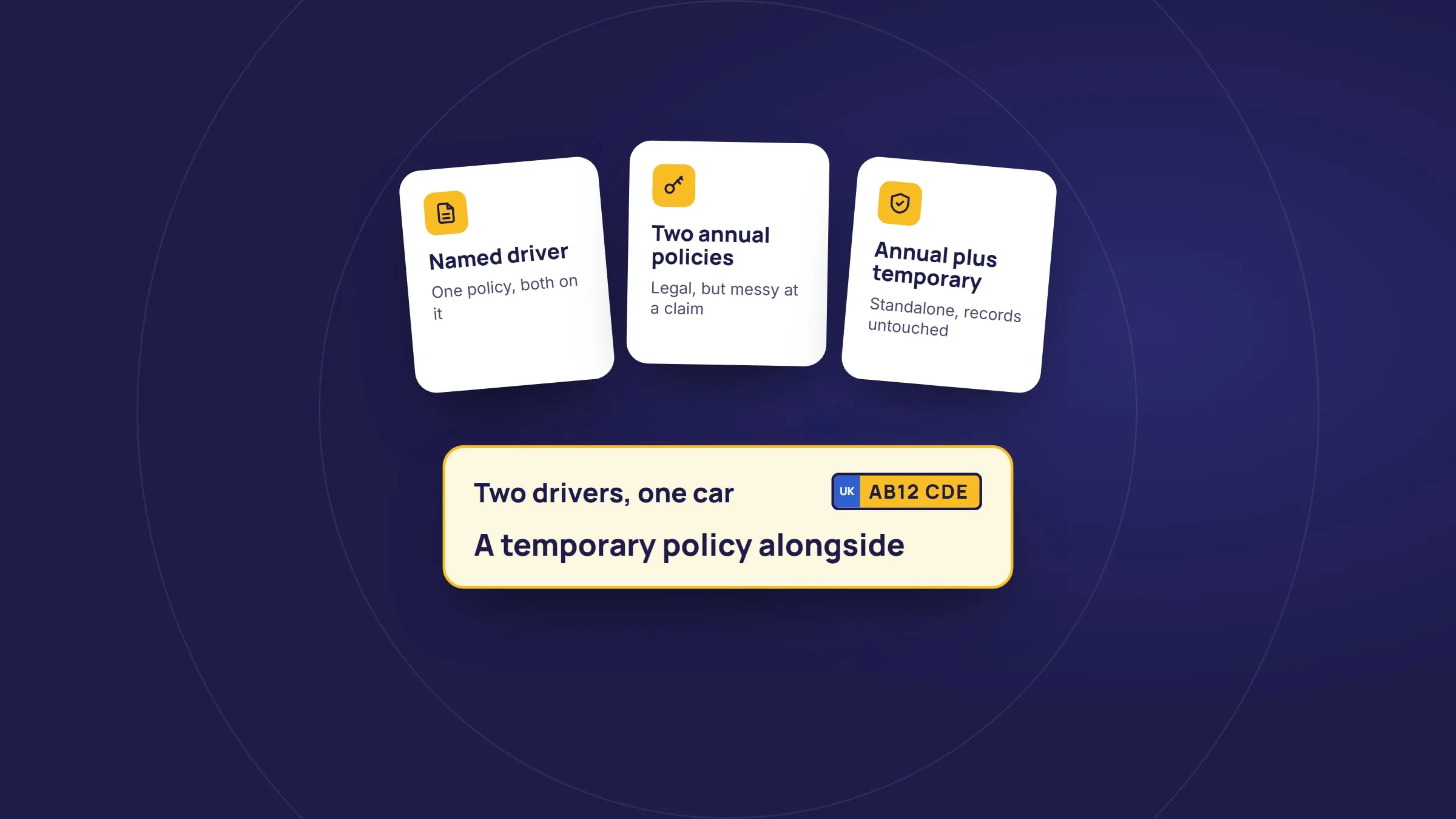
A shared car raises a question that sounds like it should have one answer and has three. Two people can be covered on one car as two names on one policy, as two policyholders with two annual policies, or as an annual policyholder with a temporary policyholder alongside. The first is the everyday case, the second is a trap, and the third is the one people do not know exists.
Can two people insure the same car?
Yes. One policy naming both drivers is the usual way. Two annual policies on one car is legal but awkward at a claim. An annual policy with a temporary one alongside it is standalone and clean.
| Arrangement | How it works | Best for |
|---|---|---|
| Named driver | One annual policy; the second person is added to it | Two people at one address sharing a car all year |
| Two annual policies | Each person holds a full policy on the same car | Almost nobody; dual-insurance rules apply at a claim |
| Annual plus temporary | The owner keeps the annual policy; the second driver buys their own short policy | A borrower, a visiting relative, a student home for the holidays |
The rest of this guide takes them in turn.
How does being a named driver work?
The policyholder asks their insurer to add you. You are covered to drive the car under their policy, they pay the premium, and any claim with you driving is theirs.
This is how most households insure a shared car, and for a year of regular use it is almost always the lowest cost. Two things to be clear about before signing up:
- The claim is the policyholder’s. A bump with the named driver at the wheel goes on the policyholder’s record and knocks their no claims discount, however many years it took to build.
- The named driver usually builds nothing. Claim-free years as a named driver do not normally earn a no claims discount of their own. A few insurers now record them; most do not.
And one thing never to do. The main driver on the policy must be the person who drives the car most. A parent named as main driver on a car their child drives every day, to bring the quote down, is fronting. It is fraud, and the policy can be voided at the first claim, the claim refused, and the fraud recorded against both names.
Can two people have two separate policies on one car?
Yes, and it is a poor idea. At a claim the two insurers apply dual-insurance rules, sharing the cost or disputing it, and the policyholders end up worse off than one policy would have left them.
Nothing in law stops two policies on one vehicle; the Motor Insurance Database simply shows the car as insured. The problem arrives when something happens. Both policies respond to the same loss, each contains a clause about other insurance, and the insurers settle between themselves under contribution rules while the policyholders wait. Each has paid a full premium for cover that overlaps the other’s.
The only case where it makes sense is a car used by two people who do not live together and who each want their own record, and even then a temporary policy for the second person is cleaner for anything under a month at a time.
What about a temporary policy alongside the annual one?
A temporary policy is standalone: its own certificate, its own policy number, its own insurer. It sits beside the owner’s annual policy without touching it, and a claim on it never reaches the owner’s record.
This is the arrangement the annual market does not advertise, because it belongs to a different product. The owner keeps their annual policy running. The second driver buys a policy in their own name on the owner’s car, for 1 hour to 28 days, comprehensive as standard, with the owner’s permission and nothing else. The broker’s panel covers drivers aged 17 to 75 with a full UK licence, on cars worth between £500 and £65,000 with a valid MOT and not on a SORN, with the minimum age, the licence types accepted and the value band varying by insurer.
What it is for:
- a friend borrowing the car for a weekend,
- a relative visiting for a fortnight,
- a student home for the summer who drives the family car a few times,
- a partner who drives twice a year and would cost more as a named driver than as a temporary one,
- a learner practising in a parent’s car, on the learner product, which normally sits on the car’s own annual policy.
What it is not for: a second regular driver all year round, where a named driver place is cheaper.
A second driver for days rather than years? A policy in their name, with yours untouched.
Get QuotesWhose no claims discount is at risk?
On a named driver arrangement, the policyholder’s. On two annual policies, whichever policy the claim is made on. On a temporary policy, nobody’s, because the temporary policy carries no discount to lose and the owner’s is not involved.
The no claims discount is the single biggest lever on an annual premium, and it is the thing a shared arrangement most often costs. A year of named driver cover is cheap right up until the named driver reverses into a bollard, at which point the policyholder loses several years of discount for a repair the named driver would happily have paid for.
The temporary route changes that. The claim is made by the temporary policyholder, on their policy, against their insurer, with their excess. The owner’s insurer is not told and the owner’s discount is intact. For an owner lending a car to someone they are fond of but do not entirely trust with a kerb, this is the reason to ask for a temporary policy rather than add a name.
Who should be the policyholder, the keeper and the owner?
They can be three different people. The keeper is on the V5C, the owner paid for it, and the policyholder bought the insurance. Insurers want the policyholder to have an insurable interest, which living with the owner or driving the car both give.
Can you insure a car that is not in your name goes through the three roles in detail. For a shared car the short version is that married couples and civil partners are routinely accepted as keeper and policyholder in either order, parents and adult children at the same address usually are, and friends at different addresses often are not on an annual policy, which is where the temporary policy comes in again.
Whichever arrangement you choose, both drivers should be able to produce a certificate with their name on it, or a certificate naming a class of driver that includes them, for that car. Driving without insurance is £300 and 6 points, and the car being insured by somebody else is no defence.